

Healthcare companies require provider credentialing, compliance, and workforce logistics to manage their operations. To effectively do this, they depend on credentialing systems like Symplr.
Symplr has long been a go-to solution for many organizations, offering a suite of tools tailored to these needs. However, as the industry evolves, so do the requirements of healthcare providers, leading many to seek alternatives that offer advanced features, better user experiences, and more responsive support.
If you’re evaluating Symplr but want to see how it stacks up against other credentialing and compliance solutions, this guide gives you the essentials:
- An overview of Symplr and where it fits
- Buyer scenarios where you may need an alternative
- Five leading competitors with unique advantages
- Expanded comparison table and evaluation checklist
Let’s get right in.
How we evaluated Symplr alternatives (2026 buyer criteria)
To keep this comparison fair and 2026-ready, each vendor was evaluated against the same set of criteria that healthcare operations leaders consistently prioritize:
- Automation depth: Coverage of credentialing workflows, PSV, roster reconciliation, renewables, and alerts
- Integrations: APIs, webhooks, and support for CAQH, PECOS, NPPES, SSO/SCIM, EHR/RCM systems
- Compliance & trust: NCQA CVO status, SOC 2/HITRUST certifications, audit trails, and monitoring capabilities
- Speed & accuracy: Credentialing turnaround times, first-pass enrollment rates, and real-time monitoring
- Licensing at scale: Support for 50-state licensing, IMLC, DEA/CSR registrations, and renewals
- Admin UX: Dashboards, bulk actions, user visibility, and ease of adoption
- Pricing & scalability: Fit for small practices, health systems, and large enterprise organizations
By applying these criteria, you can quickly match platform strengths to your own organizational needs.
What is Symplr?
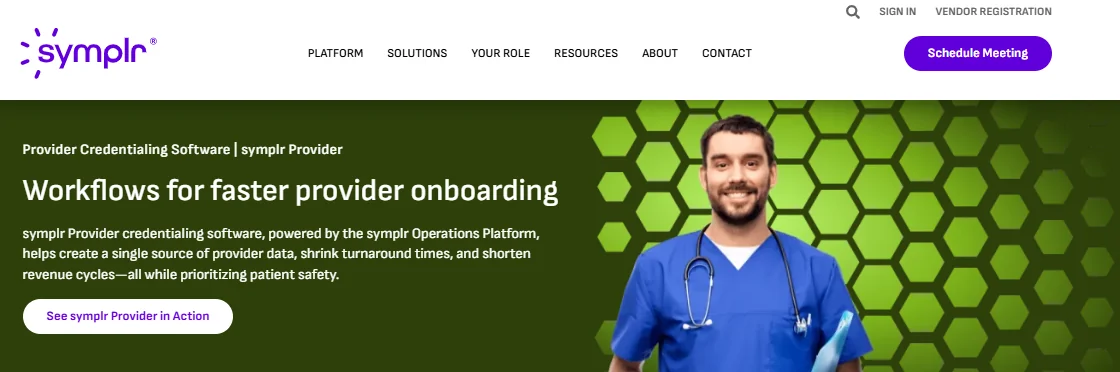
Symplr is a cloud-based healthcare governance, risk management, and compliance (GRC) software platform designed to streamline various administrative processes within healthcare organizations.
Below is a brief overview of Symplr:
Focus: Governance, risk management, compliance, and provider credentialing
Where it fits: Hospitals and large health systems needing workforce logistics plus compliance
Standout: Broad suite of compliance and vendor management tools
Key functions:
- Workforce Management: Scheduling, shift management, overtime monitoring
- Credentialing: Automated verification, provider enrollment
- Compliance Tracking: HIPAA, OSHA, and policy management
- Vendor & Contract Management: Ensures third-party compliance and centralizes agreements
Pros of using Symplr
- The platform simplifies attendance tracking, payroll processes, and credentialing workflows, saving time for HR teams and administrators
- It can store all provider data in one secure location, with features like multi-factor authentication enhancing security
- User-friendly interface with intuitive navigation
- Regular updates incorporating user feedback
Cons of using Symplr
- Some users report slow performance during peak hours.
- Feedback from G2 ratings indicates inconsistent customer service, with some users experiencing rude interactions or slow resolutions to support requests
- Several reviewers feel the interface could use a refresh to make navigation more intuitive and visually appealing
- While Symplr offers robust reporting capabilities, creating custom reports can be lengthy and complicated for users unfamiliar with the system
- The appearance of unused features in certain modules creates unnecessary confusion for users who haven't purchased the full package
Pricing
Symplr offers customized pricing based on the specific solutions and scale required by an organization. Only available upon request.
Why look for Symplr alternatives?
While Symplr provides a robust set of tools for healthcare administration, organizations may seek alternatives due to:
- Performance Issues: Reports of slow system response times
- Customer Support: Inconsistent experiences with support services
- Complexity: Some features may have a steep learning curve
- Cost Considerations: Budget constraints prompting the search for more cost-effective solutions
When you need a modern platform with better automation
Symplr has been in healthcare operations for a long time. For large hospital systems that already use Symplr for workforce management and compliance tracking, adding credentialing through the same vendor makes sense on paper. You get one relationship, one contract, one login. Symplr also runs an NCQA-certified CVO, so certification isn't the gap. Automation and day-to-day usability are.
But the credentialing product itself, formerly known as Cactus, carries some of the weight of that history.
Symplr Provider holds a 3.6 out of 5 on Capterra across 117 reviews. One reviewer described "so many clicks required to accomplish a task." The web-based version, which replaced Visual Cactus, draws mixed reviews, and one user preferred the old version over "the more challenging and unappealing web-based Cactus."
The automation gaps go deeper than the interface. One reviewer reports that the LEMM license crawler only works for MD and DO boards, so dentists, podiatrists, and other provider types need manual checks. The same reviewer notes that when a group renews malpractice insurance, you can mass-update the expiration date but can't mass-upload the certificate of insurance to each provider.
Customer support has changed since the Cactus acquisition, too. Long-time users report that support has slipped: one wrote, "Since CACTUS merged with symplr, Customer Service has declined," and another said resolutions take longer. For a credentialing team with dozens of providers in the pipeline, a slow response on a broken workflow stalls the pipeline.
Where Symplr still makes sense
Symplr is not the wrong choice for every team. It offers a broad suite across workforce management, compliance, and credentialing, and its CVO is NCQA-certified. It centralizes provider data and includes committee management. If your hospital system already runs on Symplr and your team is comfortable with it, staying put can be a reasonable call. The real question is how much manual work you can accept as your roster grows.
Where the gaps show up in practice
Payer enrollment is where the gap gets expensive. Credentialing and payer enrollment are two distinct processes. Symplr Provider tracks enrollment, but your team still submits applications to individual payer portals and follows up on each one. One reviewer notes that the CAQH module costs extra to implement. That's what keeps providers from billing even after they're fully credentialed.
These gaps look small one at a time. Across hundreds of providers, they add up. Each manual license check for a non-MD provider is a task someone has to remember. So is each certificate of insurance attached one at a time, and each payer portal follow-up. When a coordinator is out or the roster grows, those tasks are the first to slip.
Then there's the day-one usability question. Multiple reviewers flag the learning curve on web-based Cactus. A platform your team can navigate without weeks of training means fewer support tickets and faster onboarding for new coordinators.
Questions to ask in a Symplr demo
If you are weighing a move, put these to the vendor:
- Which provider types does the license crawler cover, and is it in the standard package?
- Can we mass-upload documents, such as certificates of insurance, or only mass-update dates?
- Is the CAQH module included, or does it cost extra to implement?
- Beyond tracking, who submits payer applications and follows up on them?
- How fast does support respond to a broken workflow, and what happens when that target is missed?
What switching actually changes
The test is simple. Look at how your coordinators spend their week. If most of their hours go to data entry, manual uploads, and navigating a clunky interface, that's the answer. The platform is organizing work without automating it.
Switching to Assured changes the work itself. Verification runs in parallel across 2,000+ primary sources, so committee-ready files take under 48 hours. Assured sends payer applications within 72 hours of receiving complete provider data, with follow-up on a set cadence. A dedicated implementation specialist and customer success manager check in weekly. Support responds in under 24 hours.
Platinum Dermatology Partners is one of the dermatology groups that work with Assured. A platform built around automation can run license monitoring, verification, and payer enrollment follow-up without someone triggering each step, which matters most for groups adding locations and providers regularly.
Symplr Provider is a credentialing tool. The question is whether your team's hours are going to credentialing work or to working around the tool.
Top 5 Symplr alternatives in 2026
1. Assured (the best alternative to Symplr)
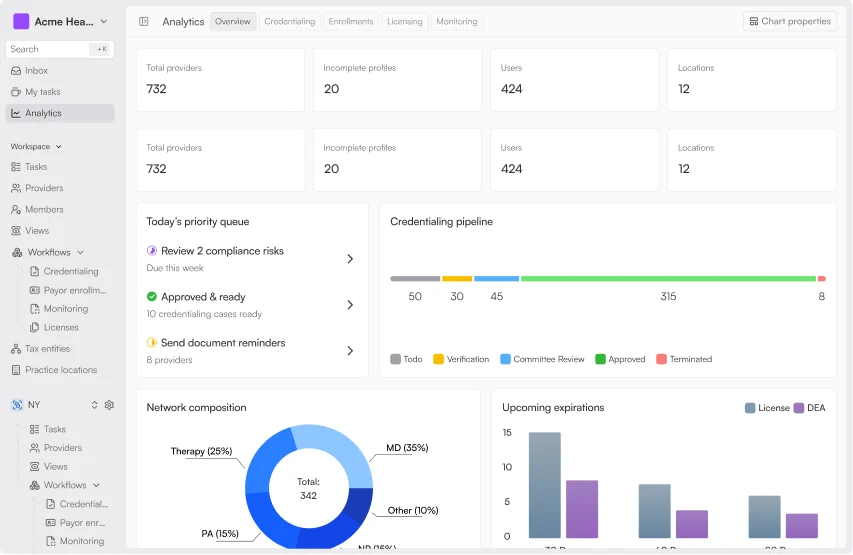
Assured is an all-in-one provider management solution tailored for healthcare organizations. It is designed to streamline critical processes, including licensing, credentialing, payor enrollment, and network management.
- Unique angle: A full-stack platform combining licensing, credentialing, payer enrollment, and network monitoring in one system
- Best for: Healthcare organizations needing automation across the full provider lifecycle
- Standout automations: PSV automation; CAQH/PECOS sync; delegated roster consolidation; license/OIG/SAM monitoring; renewal triggers
- Integrations: APIs/webhooks; EHR/RCM; CAQH, PECOS, NPPES
- Compliance: NCQA-certified CVO
- Limits to note: Complex custom workflows may need implementation support; smaller orgs may face a learning curve
Pricing: Custom pricing based on organizational needs and scale. Only available upon request. However, you can book a free demo here.
The Assured advantage
Unlike point solutions that only handle scheduling, reporting, or compliance training, Assured unifies the entire provider management lifecycle:
- One platform, many functions: Licensing, credentialing, payer enrollment, and continuous network monitoring
- Automation-first: PSV, roster reconciliation, CAQH/PECOS sync, all streamlined
- Compliance you can trust: NCQA
- Scalable across orgs: From small provider groups to national health systems
This makes Assured more than just another Symplr competitor; it’s a future-proofed solution for automated credentialing and compliance.
2. QGenda
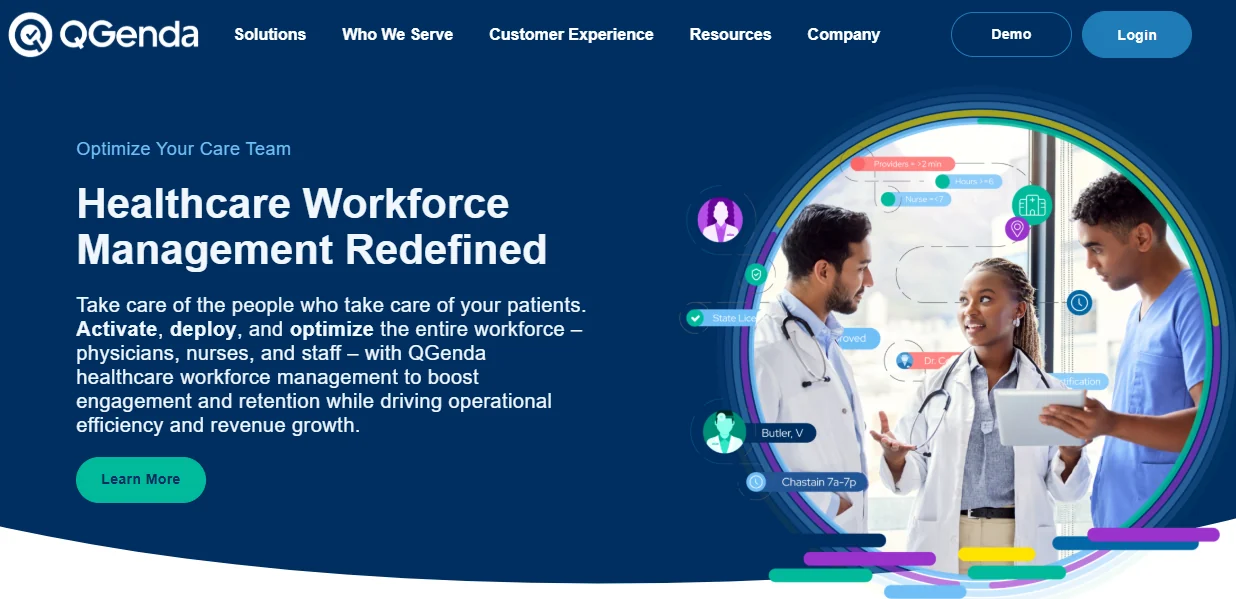
QGenda specializes in workforce management, offering solutions for provider scheduling, credentialing, and analytics.
Its platform helps healthcare organizations optimize staff utilization and ensure compliance with credentialing requirements.
- Unique angle: A scheduling-first platform that combines workforce optimization with credentialing
- Best for: Hospitals and health systems focusing on scheduling efficiency
- Standout automations: Automated provider/nurse scheduling; credentialing workflows; payer enrollment tracking
- Integrations: HRIS, EHR, clinical communication systems
- Compliance: Supports credentialing requirements within scheduling systems
Pros of using QGenda:
- Many users appreciate Qgenda's intuitive design, which makes navigation and schedule management straightforward.
- The automated scheduling feature is praised for saving time and reducing errors in complex scheduling scenarios.
- Users report positive experiences with Qgenda's support team, noting their helpfulness and responsiveness.
Cons of using QGenda:
- Some users mention that the platform's extensive features can be overwhelming initially, requiring time to learn and adapt.
- A few reviews indicate that specific customization options are limited, which can be restrictive for organizations with unique scheduling needs.
3. MD-Staff by ASM
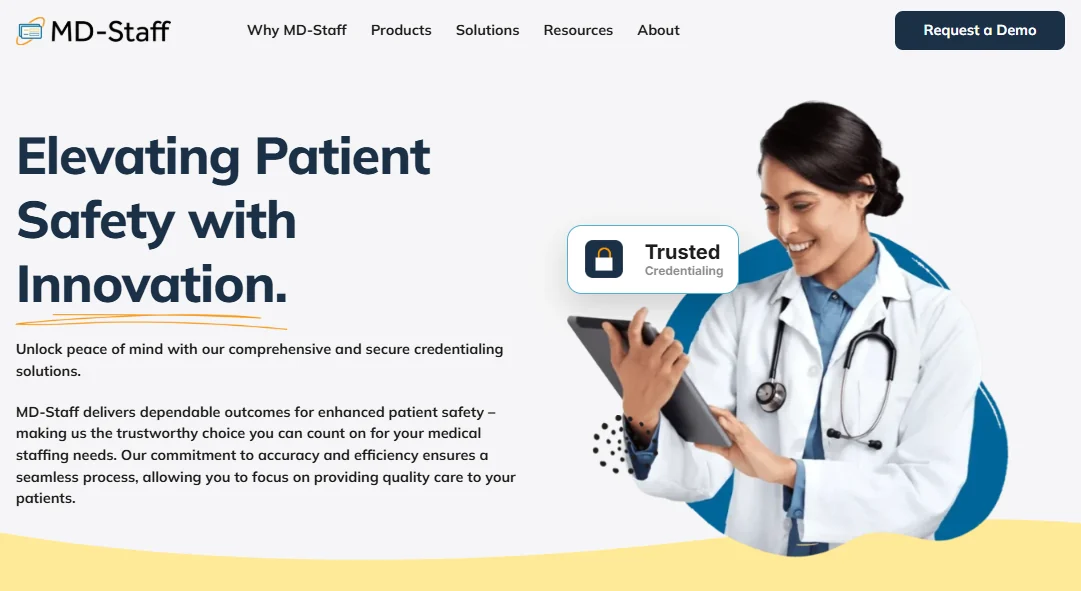
MD-Staff, developed by Applied Statistics & Management, Inc., is a comprehensive, cloud-based credentialing and provider information management platform designed to streamline healthcare operations.
Its features include automated workflows, real-time tracking, and robust reporting capabilities.
- Unique angle: Built for credentialing depth and reporting, with a modular design for customization
- Best for: Organizations prioritizing detailed provider credentialing and privileging
- Standout automations: PSV automation; privileging; peer review support; enrollment management
- Integrations: EHR, HR, payroll tools; Microsoft Office/Adobe PDF reporting
- Compliance: Centralized verification organization (CVO) services
Pros of using MD-Staff:
- The platform has an intuitive and user-friendly interface, allowing staff to navigate and utilize the software with minimal training
- It supports seamless integration with other systems such as electronic health records (EHRs), human resources (HR) software, and payroll tools
- Users can access MD-Staff features and information from mobile devices, allowing for on-the-go access to critical data and functionalities
- They provide exceptional customer support to assist users with any technical issues or questions they may have
Cons of using MD-Staff::
- Some users find the software’s customization options limited, potentially not catering to highly specific or unique workflows without further development
- Despite its user-friendly design, there is a slight learning curve for new users unfamiliar with similar software solutions
- MD-Staff’s pricing may be a significant consideration for smaller healthcare organizations with limited budgets
4. Verisys
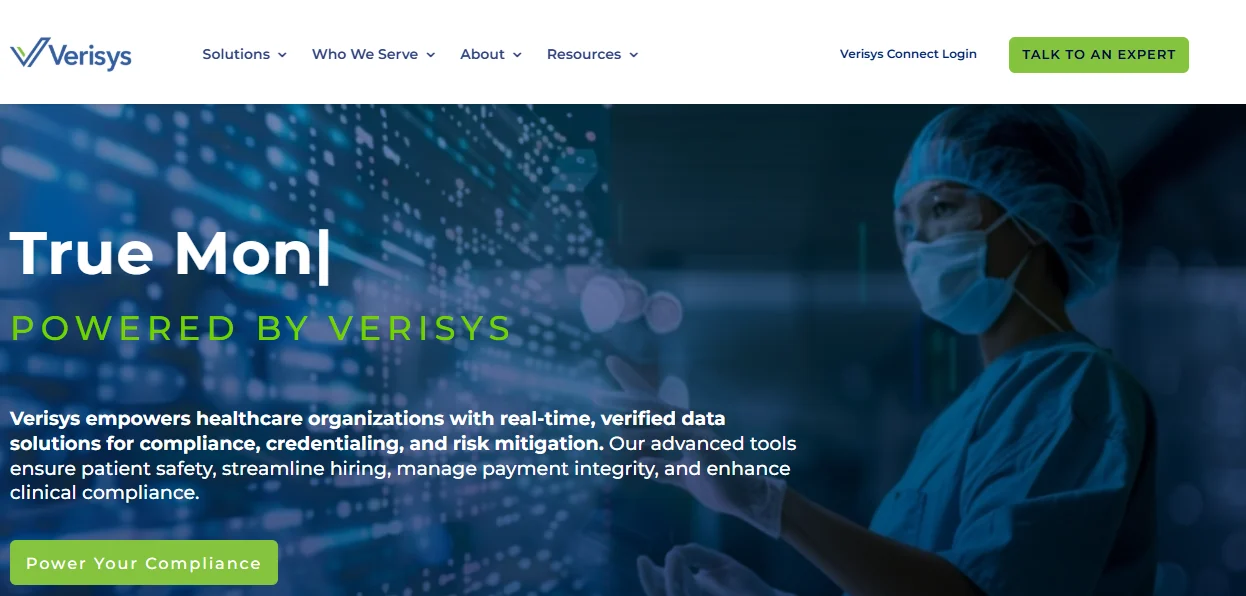
Verisys offers comprehensive credentialing and provider data management solutions. Its platform ensures compliance and reduces risk by providing verified data and continuous monitoring of healthcare providers.
- Unique angle: A compliance monitoring specialist platform with one of the most comprehensive exclusion and sanctions databases
- Best for: Organizations prioritizing continuous monitoring and risk mitigation
- Standout automations: FACIS® database access; real-time license verification; provider directory management
- Integrations: Limited compared to peers
- Compliance: Strong in exclusions monitoring and real-time eligibility screening
Pros of using Verisys:
- Verisys streamlines processes such as OIG and OFAC searches, improving compliance efficiency
- The platform is known to excel in provider database collection and document management
- It is intuitive and straightforward to navigate
- They have a strong customer support system
- It gives reliable and detailed information, which helps with decision-making
Cons of using Verisys:
- It has limited integrations
- It needs better customization
- Support can be slow during busy periods
- The layout can be confusing or hard to read
5. Incredable
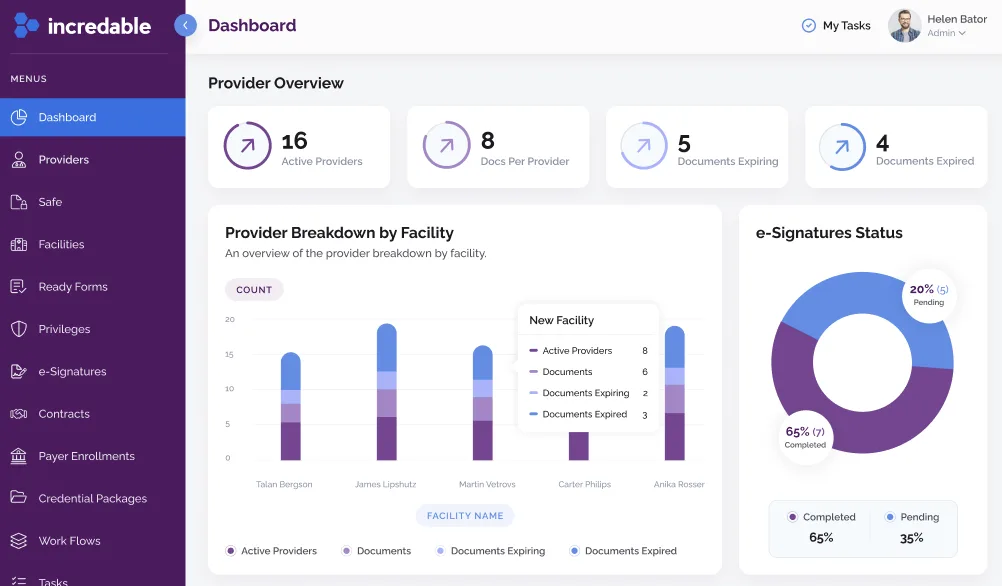
Incredable is credentialing software built for smaller hospitals and outpatient organizations, including regional, rural, and critical access hospitals, surgical centers, and FQHCs. It was previously called Ready Doc and is owned by Intiva Health.
Plans are priced as a flat fee with unlimited provider profiles, so adding providers doesn't raise the bill. Providers keep their documents, e-signatures, and expiration alerts in the Incredable mobile app. Your team runs primary source verification, sanctions checks, and custom workflows from a single dashboard.
- Unique angle: Flat-fee credentialing software with a provider mobile app, where each provider gets a digital Credential ID with a scannable QR code
- Best for: Regional, rural, and critical access hospitals, surgical centers, and FQHCs
- Standout automations: PSV for state licenses, DEA, NPI, and OIG exclusions; Ready Forms that auto-fill payer and CAQH applications; 30/60/90-day expiration alerts
- Integrations: CAQH; built-in e-signatures; provider mobile app
- Compliance: Sanction and exclusion monitoring across OIG, SAM, and state medical boards, with an audit trail for every verification
Pros of Incredable:
- Flat-fee plans with unlimited provider profiles, so cost doesn't climb as the medical staff grows
- Providers upload documents and sign forms from their phones, which means less chasing before files go to committee
- Implementation typically takes about a week once Incredable receives your data
Cons of Incredable:
- There's no outsourced CVO option, so your team still does the credentialing work inside the software
- Reporting tools may feel limited for advanced needs
Comparison table
Decision guide + scorecard
There isn’t a single “best” alternative; it all depends on your workflow, budget, and what’s slowing you down right now.
So, before choosing a Symplr alternative, ask:
- Do you need scheduling efficiency, credentialing depth, or a full-stack solution?
- Must the platform handle 50-state licensing, DEA/CSR?
- What systems must it integrate with (EHR, HRIS, billing)?
- Do you prioritize compliance monitoring or training?
- What SLA (Service Level Agreement) and support levels do you require?
Scorecard
Why Switch to Assured
Unlike Symplr, which leans heavily on workforce and compliance modules, Assured integrates all aspects of provider management into one system, including licensing, credentialing, payer enrollment, and ongoing network monitoring.
- Automation-First Approach: Assured reduces manual work through automated PSV, CAQH/PECOS sync, license renewals, and real-time roster reconciliation. This automation translates directly into faster credentialing times and reduced administrative overhead
- Compliance You Can Trust: As an NCQA-certified CVO platform, Assured ensures credentialing and enrollment processes meet the highest standards while keeping sensitive provider data secure
- Scalable Across Organizations: From small practices scaling to 50 providers to large health systems managing thousands, Assured adapts to growth with multi-state licensing, DEA/CSR support, and IMLC compact licensing
- Transparency and Speed: Where Symplr users often complain about performance issues and complex navigation, Assured prioritizes ease of adoption and real-time visibility, with most organizations seeing reductions in credentialing time by over 50%
Switching to Assured means moving from fragmented, compliance-heavy workflows to a streamlined, automation-driven platform built for modern healthcare operations.
Conclusion
Symplr is a solid option, but it’s not the only one. In 2026, platforms like Incredable, MD-Staff, Verisys, QGenda, and Assured are offering healthcare teams flexible, focused alternatives that can simplify operations without overcomplicating your tech stack.
If you're looking for a platform that’s streamlined, easy to adopt, and built specifically for modern credentialing workflows, Assured is at the top of the list. It’s especially great for teams that are tired of clunky systems and want to get things done faster.
See why more healthcare teams are switching to Assured: withassured.com
Sometimes, the simplest choice is also the smartest.
How long does it take to transition from Symplr to Assured?
Can Assured handle multi-state credentialing?
What are the biggest complaints about Symplr Provider (Cactus)?
Is Symplr Cactus the same as Symplr Provider?

Assured Health, Inc.
333 Seventh Ave, Suite 1701
New York, NY 10001